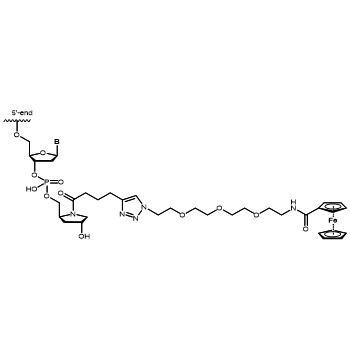
Ferrocene is a redox-active organometallic compound. The iron atom in this sandwich complex can donate or accept an electron through reversible oxidation/reduction (Fe(II) <-> Fe(III)).
Thus, ferrocene is ideally suited as a marker for electrochemical detection and potentiometric measurements.
In one application variant, ferrocene-labeled oligonucleotide probes are bound to gold surfaces via thiol linkers. When the probe binds to the target molecule, the distance between the ferrocene and the electrode surface changes, triggering a potential change that can be detected using appropriate measurement methods.
In addition to ferrocene, biomers.net offers a wide range of other electrochemically active modifications [Electrochemical Modifications]. For coupling to surfaces, we offer thiols, various amino linkers, and biotin. Alkynes offer another option, as they are suitable both for coupling to gold surfaces and for click chemistry [Linkers and Spacers].
Literature:
1. Oligonucleotide Conjugates for Electrochemical Probing of DNA. Ihara T, Maruo Y, Takenaka S, Takagi M; Nucl. Acids Res. (1996), 24 (21), 4273-80. doi: 10.1093/nar/24.21.4273
2. DNA sensors using a ferrocene-oligonucleotide conjugate. Nakayama M, Ihara T, Nakano K, Maeda M; Talanta (2002), 56 (5), 856-66. doi: 10.1016/S0039-9140(01)00659-2